So Long Thought Leaders. Thanks for all the Likes

Thought Leadership has become a boom industry.  Claims to thought leadership are everywhere. Some days it seems every second profile on Linkedin, Twitter or some other social media or traditional media channel is someone claiming thought leadership.  The TEDX movement has expanded the audiences for tightly packaged and highly engaging content. Content marketing has created an impetus for many to pursue thought leadership as a driver of their business success. An explosion of self-publishing has meant your own book is almost a required calling card in industry.

We have also seen the beginnings of a pushback on this overabundance of thought leadership. Australia has seen the fall of the CEO of a large membership organization when questions were raised around the level of investment that organization made in his personal thought leadership profile. When consultancies start to sell the idea that anyone can be a thought leader on a $1m income in few easy steps it is tempting to think we have reached the ‘shoeshine boy’ moment in the boom of thought leadership.

So You Are A Thought Leader?

I hear thought leader a lot. I have even been called one. Occasionally I have tried to use it, but I have given up on that designation because whenever, I hear it I have this reaction:
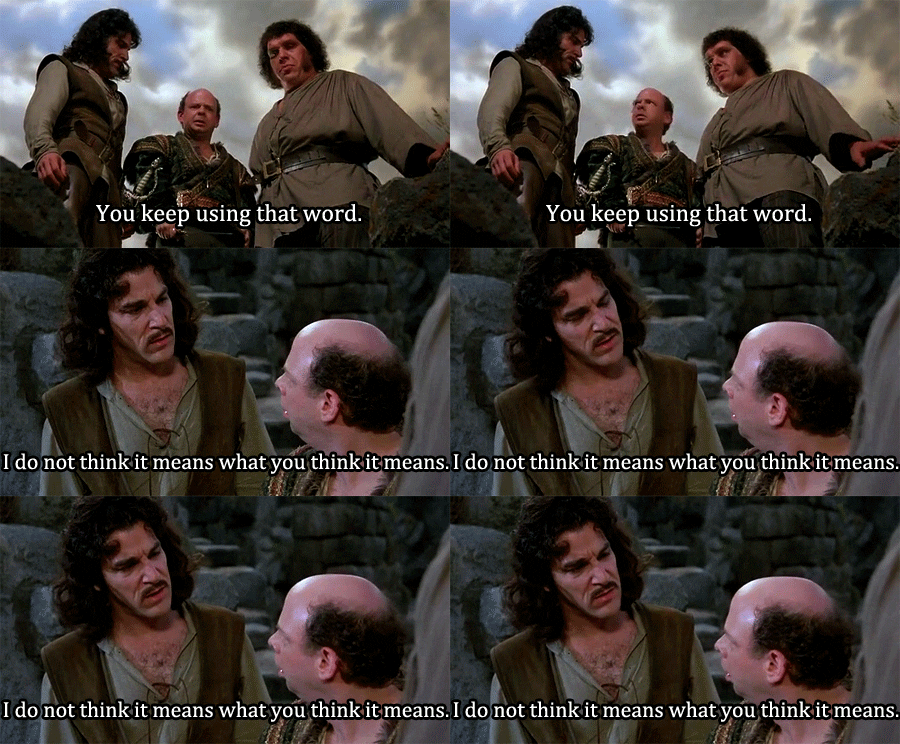
Many people use thought leader to describe themselves because they share thoughts. Too often both their thought and their leadership is open to real question. Sharing ideas in networks is the start, but hardly the end of thought leadership.

We should demand our thought leaders have actual insights into change in the world and a capability to influence on how others will execute that change. David Session’ The Rise of the Thought Leader in the New Republic contrasts the thought leader with traditional public intellectuals based in academic research. In the article, Sessions quotes Daniel Drezner, that thought leaders

“develop their own singular lens to explain the world, and then proselytize that worldview to anyone within earshot.”

A cursory examination of thought leadership demonstrates the challenges of discovering actual insight. Much of thought leadership is a careful packaging of self-evident platitudes. Much of the research that underpins it does not stand up to scrutiny.  I have shelves of business books, both published and self-published, that use the same businesses as examples for propositions across widely divergent domains. Usually the thought leader has had no actual involvement in that organization, they are merely interpreting public reports and enhancing the reporting with their own interviews to confirm a hypothesis.

Leadership is more than a claim to a hierarchical superiority over others (which is itself suspect in the realm of thought). True leadership is inspiring others to act for their betterment and the world’s by engaging with their drives and purposes. Leaders are not just visionaries with catchy phrases and three step plans. Real leaders engage in the hard pragmatic and practical work of ongoing change. Unfortunately many thought leaders eschew complexity, doubt or challenge because it interferes with the marketing pitch.

Our use of leadership in this context also confuses social media followership and entertainment audience gathering with actual leadership of action. We define ourselves by those whose ideas we choose to embrace. We may consume large amounts of thought as entertainment in many media formats. We can follow others for years without the slightest chance of their thoughts influencing any tangible action on our part. A real movement is not an audience led by a prophet, it is a self-governing community of action.

Evidence that the thought leader has contributed an original insight, that the thought actually contributes to any outcomes claimed and that the idea is applicable more widely by others is less common than you might think. With a strong emphasis on entertainment and emotional appeal, much of thought leadership leaves you with the cloying sugary aftertaste of fast food.  So let’s talk briefly about TED.

Let’s Talk about TED

TED has created some of the major global thought leaders and magnified the influence of others through online videos. There are undoubtedly great TED talks that bring attention to critical issues in world affairs, share important scientific breakthroughs or help people to move forward with better approaches to their lives.  The power of law of viewership of these great examples has also sustained a long-tail of weaker thought leadership.

The success of TED and its expansion though TEDX have come to define what a thought leader looks like for many people. The format has been widely copied across conferences as it appeals to attention spans and delivers entertaining and highly engaging talks when properly produced. I’ve delivered a TEDX style talk and I am always asked for one by conference organizers. The TED talk format is the gold standard. The format has become so predictable that even TEDX has engaged in parody:

It has become trendy to blame TED for its optimism, its simplicity, its more dubious talks and predictions, its evangelism, and much more. The reality is that TED talks and the copies in other forums are entertainment. We consume this entertainment in our quest for easy digestible ‘thought leadership’ and many race to be a part of the format because of the demand for this entertainment. If you want to scale your media appearances, consulting revenues and followership on social media, a successful TEDX talk still offers a major step forward. TEDX can help you gather your own cluster of believers.

Let’s Move Beyond Thought Followership

In an era of ‘fake news’, thought followership is one of the biggest problems in society. Dividing our society up into rotating clusters of believers is doing little to help us to create workable civil societies into the future and to address major social issues. Our civil societies need real conversation and to find the working common ground of actual change. Echo chambers, simple messaging and entertaining bluster are in abundant supply. We need the practical leadership of change in our communities.

We need a new scepticism in the ideas we consume, who we follow and the entertainers we choose to promote.

Self-governing Communities of Action

Many of us have flirted with thought leadership because it seemed to offer opportunities of status, fame and influence. We want an opportunity to improve our hierarchical position and thought leadership seemed a way to make that happen. Sadly, the power law of thought leadership consumption means success is harder and a longer term proposition than its promoters will suggest.

A better way forward is purposeful action. We can each get the rewards of taking small steps to influence change directly ourselves. Our experiments will help us learn far more on what needs to be done. Connecting with others and collaborating on change provides opportunities for far greater social and emotional rewards and a much greater impact than thought leadership. We need to start to value community leadership as much if not more so than thought leadership. If anything is going to make our communities better, it is not thought leadership, it is small self-governing communities of action reaching out across society to make meaningful and purposeful change.

So what movement are you starting today? Just remember don’t start with the blogpost, the talk or the book, start with action.

Never doubt that a small group of thoughtful, committed citizens can change the world; indeed, it’s the only thing that ever has. – Margaret Mead
Chats, Conversations, and Collaboration: A Deeper Look

The discussion of collaborative tools has resolved relatively quickly into two clear camps, the Slack/Microsoft Teams/Hipchat camp and the Yammer/Workplace by Facebook camp.  Debates are continuing as to which mode of interaction is the richer.  Stowe Boyd has described a difference between Work Chat (the former camp) and Work Media (the latter camp). Stowe’s preference is for Work Chat as he views it enables deeper work. Others have made equally strong arguments against chat as a mode of interaction.

My experience is that the success & value of any of these tools depends on three key elements: strategy, context and change support. No piece of technology is guaranteed to achieve any work outcome without considering the desired change in human behaviour in the current context of the organization.  The Collaboration Value Maturity model focus on how adoption maturity can be facilitated in any of these tools. My discussion of Chats, Conversations, and Collaborations is an effort to add another tool to the process of organizations considering their way forward.  This post will dive deeper into Chats, Conversations, and Collaborations as human interactions to highlight why they matter.

Interactions, Not Tools

This post will focus on human interactions, not the tools. Why? Changing the human interactions is what delivers the value.  We need to keep this clear as we target changes in behaviour and we consider workplaces that increasing have multiple platforms (& passionate advocates for each platform).  The role of a community manager in shaping the strategic value of collaboration in the organization is to be able to navigate all these platforms and to help the users of each to maximize the value of their work collaboration needs.  This is an exercise in coaching the human interaction of collaboration, not platform advocacy. If you don’t know what you want, you can’t shape the interactions that way.

No tool is focused on one form of interaction, but each is better suited to facilitate one mode. You can easily chat in Slack or Teams. They are chat platforms. You can carry out a conversation too, but you will have to deal with the interruptions of other colleagues chats and the fast moving stream of messages. You can chat in both Yammer and Workplace, but both tools endeavour to push instant messaging style interactions to other channels to reduce noise and handle chats greater demand for velocity.

We also use these interaction patterns in other forms of technology and other interactions around the workplace. Understanding the different roles and value of chats, conversations and collaboration can help us be more effective in the way we use text messaging, email, meetings and workshops in our organisations.

Chats vs Conversations – Confirmation, Context, and Coaching

I have described Chats as ‘Shared Information” and Conversations as “Shared Understanding”  Chris Slemp recently asked me to clarify this distinction noting that to many a difference between information and understanding might sound like ‘splitting hairs’. As a long term practitioner in collaboration, a deep thinker on how collaboration can create value and how the different platforms are better used I always value Chris’ insights. I agreed with Chris that the distinction is a fine one and that in our action-oriented organisational work cultures we are not used to reflecting on how we work and what makes our work more effective. Any thing that smacks of philosophy or models of thought is usually disparaged as being impractical and a waste of time.

Here’s how I explained the difference:

I can show you the data that climate is changing. That is ‘Shared information’. If you still believe it’s not an issue there’s no Shared Understanding. (If that topic stirs too many political issues or debate, substitute ‘the project is behind its burn down’. It works just the same)

Just because I transmit information doesn’t mean it is received and certainly doesn’t guarantee it is understood. We need shared context to interpret communication effectively and we also need to be able to navigate our own biases, distractions, worldviews and priorities to understand others. Choices of channels, relationships and available feedback loops. influence our perceptions and processing of any information. In our digital age, the idea of rapid fire exchange of information between humans is an appealing and ever present one. Too often we fall victim to the view that humans are like computers and will process each new piece of data immediately on receipt. George Bernard Shaw supposedly remarked

‘The single greatest problem in communication is the illusion that it has taken place”

As an aside, in information theory terms a Conversation is probably better described as seeking to achieve ‘shared knowledge’, where knowledge is when information becomes an actionable pattern, but that is an even more finicky technical distinction for most people. Understanding the distinction between data, information & knowledge distinction remains an under used concept and reflects the extent to which information theory and knowledge management have fallen from favour. In an era of ‘fake news’, we may be tempted to reconsider this.

Chris raised the following great example in our discussion of how we innately understand the need to navigate different patterns of interaction to achieve meaningful outcomes:

So, similar to people wanting to take email exchanges that go on too long into a face to face meeting, you’re positing that chat is for all the quick little exchanges we need in order to get our shared work done, and anything “meaty” needs be escalated to a forum. Conversely, the weightier matters were previously ironed out in a forum, and the picky details (information) are exchanged in chat.

Email is terrible for shared understanding because when we read we’re not forced to confront our biases and worldview. For example, it takes a whole cycle of email to attempt to correct me on a view and I will inherently resist ‘correction’. Email does not offer a relationship to keep me engaged in the discussion long enough to see my error. When I converse with another I’ve got a greater chance of having differences understood, exposed and explored. My experience is that forums do this better than email & chat tools. Partly this is an outcome of threaded discussions with a slower velocity and higher context. Seeing a conversation in the context of all of its information helps me find to find a shared understanding with others.  Text and chat appear in my context and are often shorn of supporting information or relationships. This can lead to confusion or misunderstanding when language is flat, concise and devoid of tone.

It’s too common for people to read email, text or chat and not get the information expected by the sender. Think of the classic CYA ‘everything’s going well but..’ email. So many times the recipient comes back later and says ‘how could this happen? you sent me an email telling me everything was ok’. The sender says ‘I was reassuring you before I highlighted an issue’. We chat to confirm our expectations. We discuss to explore our understanding.

However, one additional benefits of the conversation forum is transparency.  Transparency of lack of shared understanding invite others to coach the conversation. Some times third parties have a critical insight to bring people together in shared understanding or can better see the dysfunction. I have seen many debates in collaboration platforms where two opposing opinions could not find reconciliation until a third party joined in that group or thread to supply a missing part of context or to help clarify the language of one of the participants.

A Deeper Reflection on Collaboration

Talk is cheap. Doing is where the value gets created. If your collaboration platform is just about chats and conversations, then your senior executives will get bored and seek a better way.

Where most collaboration platforms fall short is that the organisation has not defined the value to be created and maintained an expectation that the discussion on the platform will advance the real work of the organisation.  Discussing abstract capitalized nouns, like innovation, digital transformation, quality, or employee engagement, can seem valuable. A richer conversation within your organisation and greater transparency will help your organisations performance. What is far more valuable is when the collaboration platform is the vehicle for the work of the organization and enables employees to lead change.

The Collaboration Maturity Model highlights the tipping point when this work begins.  The tipping point begins when employees move beyond just sharing information.  When employees begin to see the collaboration platform as a vehicle to solve work issues or to create new ways of working, the beginnings of change and innovation.

Some of our commonest issues in organizations are simple issues of misalignment and misundertanding.  Two processes don’t align. Two teams goals don’t enable coordination of their outcomes. The current targets no longer connect to the strategic outcomes sought. Solving these issues can be as simple as a conversation to highlight the issue and agree changes to fix it.  However, more commonly there is a project of multiple individuals and teams to make the change happen.

Collaboration also starts to offer organizations new models of work that fundamentally change the traditional linear process of production along value chains that cut across silos. We are not adding a layer of conversation on top of work. Collaboration offers new ways of working. Crowdsourcing, co-creation, agile methods of work, design thinking and more approaches enable teams to rethink each step in their process, turning interaction, feedback and priority setting from a one-off process to a continuous adaptation.  All the stakeholders can be a part of the process as it develops through iteration.

Even more radically collaboration enables organisations to let employees explore greater autonomy in the achievement of goals.  The autonomy is safely underpinned by transparency of the work underway, clear networks of relationships to support the employee and a sense of shared purpose to facilitate the new interactions. Leadership in this context shifts from planning, motivating and managing the change to inspiring, coaching and shaping the employee’s work and the outcomes.  In this context, collaboration offers organizations a new way to plan, not for specific tasks and outcomes, but for the emergence of new strategic value.

Social Technologies in Business: A Review of Themes

208172004_01

We have reached a time when the release of a book on social approaches to business is almost unremarkable. Last month saw the publication of Social Technologies in Business: Connect | Share | Lead created by Isabel De Clercq. Having been a participant in the process of this book, come to know, respect, and admire all the contributors and contributed to three of the essays in this book, I am an enthusiastic fan of the book. With far too much bias to claim objectivity, rather than review the book, I will discuss three key themes that come out from my reading of the contributions overall.

The Value of Working Out Loud

This book is a testimony to the value of working out loud.  Naturally, given the focus on social technology, working out loud is woven throughout the essays in the book, but it is also a strong example of the value of practitioners working out loud. The pieces are by practitioners and focus on practically sharing the challenges and lessons won in a concise & engaging style. Whether it is how to convince management, how to lead in social or practical tips to win adoption and value the book is full of rich detail that other practitioners can use. Many of the pieces are collaborations of the perspectives of multiple contributors.  Not all the authors agree and these pieces sizzle with the interplay of ideas still developing.  That many of the contributors met through sharing on Twitter and other social communities are reflected in the strength of the shared themes throughout the book.

Digital Transformation is Human Transformation

Again and again, the authors return to the theme that an effective digital business is one that uses digital tools to enable more from its human employees.  Digital transformation requires focus on the change in human behaviour to see the benefits of new ways of working by employees. Engaging purpose, building capabilities and supporting this change is work we will be doing for years to come. Social and digital technologies are built into our systems, processes, and approach to work now. The challenge still is to help people and organisations to get the value of these tools through change.

Change Takes Leaders and Everyone Can Lead in Networks

The networks created by social technologies in business enable new models of leadership. We are no longer entirely dependent on the top of the hierarchy to guide and shape change. It certainly helps to have senior management support for any transformation, but networks have the ability to empower employees and to surface the change agents in their midst.  The organisations and the case studies in the book highlight the value of enabling change agents to experiment, adapt and learn with the support of peers.  There’s also more than enough room in these networks for a little fun and the creation of transformative business value by harnessing the potential of people throughout the organisation.

Thanks to the many contributors to the book for their generosity and time in sharing ideas and stories.  Thanks to Alison Williams for her work editing the book and distilling the takeaways from the pieces.  Thanks especially to Isabel De Clercq for passion, her vision and her many efforts in bringing together the contributors to the book. Her handiwork is evident from the list of contributors, to the quality of the design and the diversity of topics covered.


The Critical Culture Fix

Posters in Facebook Singapore’s foyer

Change Agents Worldwide is a Workplace Services partner for Facebook. On a recent visit to Singapore I visited Facebook’s offices and saw examples of their famous propaganda posters on culture. One of those messages is a critical issue in culture of any large organisation. 

Somebody Else’s Problem. 

Without leadership, the interplay of bureaucracy and silos builds learned helplessness in employees. Martin Seligman first described learned helplessness as when animals or people stop trying to avoid adverse stimuli. This phenomenon occurs when we experience repeated inescable shocks. 

Learned helplessness develops when our natural instincts to act are frustrated repeatedly. A bureaucractic and siloed organisations discourage employees from trying to make change. Change requires approval from some higher power or change requires the cooperation of someone else in their team or another silo (who has their own issues of competing priorities or requiring approvals to act). After repeated frustrations, employees can adopt the attitude that change is someone else’s problem. 

The Critical Fix

Nothing is somebody else’s problem. This mindset confuses responsibility for doing the work of fix with accountability to see a fix completed. Even in the most siloed and bureaucratic organisations, you may not be able to exercise the responsibility to do the work but you should retain accountability to see a discovered issue fixed. Denial of permission, budget or collaboration is an obstacle, not an excuse. 

Leaders need to help organisations to create a culture where the expectation is that problems will be fixed. The management of responsibility and accountability in the organisation must enable and encourage employees to fix issues. The way to avoid learned helplessness is for leaders to role model the way forward and break the inescapable patterns. 

The Professional Neo-Generalist

Much of my career I felt I was an amateur. Because I changed industry and field often, I worked in environments where others had deeper and more specialised expertise. I had fallen into the common trap of confusing generalism and amateurism. A society that venerates specialism treats anything less than a dedicated single specialism as unprofessional. The Martin and Mikkelsen’s book The Neo-Generalist helped me understand the role of a Neo-Generalist and the unique value that I brought to those roles.  Reading Steven Pressfield’s Turning Pro has helped me understand better the distinction between an amateur and a professional. This post explores these two important concepts for anyone who has diverse interests.

Amateur and Professional

Steven Pressfield’s The War of Art was a book I highly recommend to anyone looking to understand how to make a greater contribution in life. In this book he describes the battle against Resistance that artists face when they choose to tackle a creative endeavour. Resistance is all the fear and excuses we summon to get in the way of practice of our purpose and best work. The War of Art introduced the concept of Turning Pro, the moment when an artist determines to begin the consistence battle against Resistance and to create consistently.  His book Turning Pro, explores amateurism and professionalism in greater detail.

The distinction for Pressfield in Turning Pro is as follows:

“Each day, the professional understands, he will wake up facing the same demons, the same Resistance, the same self-sabotage, the same tendency to shadow activities and amateurism that he has always faced. The difference is he will not yield to them. He will have mastered them and continue to master them” (Note: Pressfield alternates gender in referring to the professional and amateur throughout his book)

I recognise this battle. My belief that I was an amateur in fields of professionals was one example of the Resistance. I was self-sabotaging my ability to contribute by demeaning my contributions before I had even made them.

The Quest for Mastery Distinguishes the Professional

The critical distinction is in the last line of the paragraph above: the professionals focus on mastery. The continued effort to learn and improve through practice is what distinguishes Pressfield’s professional from an amateur who yields to the distraction of Resistance.

My focus in my roles was always to learn more because I felt I was behind my more experienced and more specialised colleagues. When they may have felt content to settle into their expertise, I felt the need to push my practice and I felt the continuing tug of a Neo-generalist’s curiosity. The tug of mastery is that there is always a better way to practice.

The Advantage of the Neo-Generalist

In their book, Martin and Mikkelsen define a Neo-Generalist as follows

The neo-generalist is both specialist and generalist, often able to master multiple disciplines. We all carry within us the potential to specialise and generalise. Many of us are unwittingly eclectic, innately curious. There is a continuum between the extremes of specialism and generalism, a spectrum of possibilities. Where we stand on that continuum at a given point in time is governed by context.

Again the concept of mastery is key to the way that Martin and Mikkelsen see Neo-Generalism.  The Neo-Generalist no longer feels restrained by the arbitrary dichotomy of specialist or generalist.  The Neo-Generalist shifts as required between the domains, pursuing better mastery of practice in each context with the most relevant of their skills, whether a deep expertise or the breadth of their practice.  This fluidity of practice and the continuing curiosity and learning enables the Neo-Generalist to see potential where the domains of expertise overlap or a particular expertise ceases to run.

The intersection of Pressfield’s concept of Turning Pro and the discussion of mastery in the Neo-Generalist highlights an important point for any Neo-Generalist.  The personal commitment to mastery is what distinguishes a professional from the amateur. Neo-Generalists can overcome the resistance and self-doubt that comes from their diversity of interests when they recognise and embrace the role of mastery and continued learning in their work. Both books explore the shadows thrown by society and our own doubts. The need to continue to learn is not a disadvantage against a Specialist. A continued pursuit of mastery is an advantage for the Professional Neo-Generalist.

Be clear that amateurism and professionalism are not tied to the exercise of expertise. They are driven by a commitment to learning. Turning Pro is a defining moment for anyone Specialist, Generalist or Neo-Generalist.  Professionalism begins with an irrevocable commitment to pursue the practice of mastery.


Collaboration is not Communication

Organizations that limit their ambition to employee communication miss the transformative nature of new collaboration patterns. An enterprise collaboration solution offers the opportunity for new two-way conversations with employees. Moving an organization from broadcast communication to two-way conversations with employees is an important change in the way employee communications occur. Don’t stop there.

Collaboration in your organization is about creating new ways of working together. In a complex and rapidly changing world, more work than ever is knowledge work and more work depends on the inputs and participation of others.  The priority is on learning together in many organizations. Collaboration is more than

Collaboration is more than a communication layer over the existing patterns of work. As shared work, collaboration is different to chats and to conversations. Collaboration involves people coming together to connect, to share, to solve and to innovate in new ways and to more effectively fulfill the organization’s purpose and employee’s personal purposes. Remember your organization creates no value talking internally. The value creation occurs when you come together to work to create value for your customers and other stakeholders outside.

Organizations need to investment in community management to help realize the strategic value of these new ways of working. Community management, whether by community managers, champions or leaders, is not just about facilitating a neat two-way conversation.  Community managers must play the roles of shaping the work, building community around key strategic priorities and creating the freedom to experiment, to change and to learn. Community management enables the transformational nature of collaboration platforms.

The demands on a modern organization mean that all organizations are looking for better effectiveness, improved customer experiences, more innovation and greater responsiveness. Two-way conversations with employees are important in this journey but more critical is enabling employees to lead change in the way they work every day. Collaboration enables the most effective, the fastest and the most innovative to lead change from every employee supported by the full capabilities of the organization.

#WOLWeek Day 4: Share

#wolweek-3

Working Out Loud Week is from 5-11 June 2017.  Working Out Loud Week is a chance for a global community of practitioners to find new freedom to work together to practice sharing work in progress with relevant communities for learning and collaboration. The theme of this WOLWeek is ‘Contribute and Create Value’

Day 4: Share

In a digital workplace, much of the value that an employee can contribute and will receive depends on sharing: openness, transparency, better use of data, better use of knowledge, learning from peers, effective collaboration, greater autonomy, agile work practices and much more.  Working out loud is a key practice to get the work in process that we all have and make it visible and accessible for the rest of the organization.  That means you need to share your work.

You have a lot to share. Take your current email and make it available. Open up the contents of your C: drive. Share your calendar so that others can see what you have going on. Share your contact lists. Share your lesson from the day. Share your challenges, opportunities, and ideas.

Sharing doesn’t have to be big. You don’t have to share with the world. You don’t have to push the message to make sure other people notice. Find a place that has one or a few relevant people and lift your work and your challenges up where people can find them.

Your contributions will begin to create value for others immediately. Improving clarity and alignment, reducing rework, and helping people better understand what you have underway. You will find that the oppenness and generosity of sharing your work will draw others in to help and to learn from your work.

There is a vulnerability of sharing work that is not perfect or that is not finished. That vulnerability can feel threatening but it is also what makes your work more engaging to others. They can see your process of work and will respect your decisions to share, provided you are clear on your process of working out loud and respect them in your sharing.

Where

Resources to assist you and your organisation with WOLWeek are available on WOLWeek.com. 

Source: #WOLWeek Day 4: Share

#WOLWeek Day 3: Contribute

#wolweek-3

Working Out Loud Week is from 5-11 June 2017.  Working Out Loud Week is a chance for a global community of practitioners to find new freedom to work together to practice sharing work in progress with relevant communities for learning and collaboration. The theme of this WOLWeek is ‘Contribute and Create Value’

Day 3: Contribute

When we think of working out loud, our thoughts often go first to sharing. We begin with how our work can be shared with others. However, in the design of these five days of WOLWeek, we have put contribution before sharing.  The generosity of contribution is what turns a network into a community.  To share effectively and for mutual benefit, it helps to begin with generosity.

Our work is built on the foundation of our knowledge, our skills, our experiences and our place in the world. Everyone has this foundation to their work and each person’s set of capabilities and context is unique. We all have the ability to contribute our attention, capabilities, and context to the work of others.

Contributing generously to others builds our networks into communities. This develops relationships for future collaboration and learning.

We don’t need to be interesting to work out loud.  We have unique abilities to contribute to others.  We need to be interested in others and contribute to their work.

How can you show interest in the work of others? How can you recognise their efforts? How can you share your capabilities and context to advance their work?

Choose someone relevant to your work and make a contribution today.

Working Out Loud Week: One Degree of Freedom

#wolweek-3

Next week is International Working Out Loud Week (5-11 June). For the week, a global community of working out loud practitioners, advocates and organizations will share their work, their lessons, and their stories.  This WOLWeek the theme is “Contribute and Create Value”.

We created Working Out Loud week to draw attention to working out loud. Importantly, we also wanted to authorize people to share their interest in or passion for working out loud.

In corporate life and in social situations, we can often worry whether we have the authority or the permission to share. Our actions are tightly constrained. Acceptable behaviour is tightly defined. Speaking out in a different way to one’s peers can be hard and discouraged. The goal of WOLWeek is to give people one little period where they have one degree of freedom to change.

Your organization may not support working out loud. Your peers may not understand working out loud. However, each individual can fight for one more bit of freedom to change using WOLWeek.  We can do so by announcing that we are joining a global movement, celebrating a recognized event and sharing the stories that will surface over the week.  The global community and conversation around WOLWeek is designed to give everyone just a little latitude to do differently for the week, to explore change and to experience the benefits of a different approach.

The transparency, collaboration, and learning of Working Out Loud are all important future of work practices. WOLWeek gives you a chance to take yourself and your organization a small step into this change.

Take it. Work out loud. Show your work to others. Invite others to learn from you and to help you achieve your goals. That small step into change under the umbrella of WOLWeek might just lead you and your organization into an extraordinary transformation.

Working Out Loud Week is from 5-11 June 2017. For more information see WOLWeek.com or WOLWeek on Twitter.

Ending The Internal War For Attention

Opportunities for distraction are everywhere. Organisations need to stop fighting the war for attention internally. If you need to fight over the attention of your employees you have a performance management problem, not an attention problem.

The War For Attention

We are familiar with the battle for our attention in all aspects of our lives. We are slammed by marketing & communication messages everywhere. The globally connected always-on world means people are now seeking escape from the buzz of demands on their attention. Digital downtime once meant waiting for slow computers. Now people are taking time offline away from the alerts. The volume of and channels for these messages keep increasing. Scott Belsky of Airbnb has described our mobile phone notifications as a tragedy of the commons where excessive use and bad behaviour is devaluing the platform for everyone.

Filtering out the attention grabbers is critical work now for each of us to manage our personal effectiveness.  Making careful choices of tools, their settings and using personal knowledge mastery skills is important for anyone to stay sane, let alone be effective in their lives and work. Importantly, the set of choices that make each individual effective is unique to the individual, their context, and community. The tools and techniques can help individuals to better manage attention and personal effectiveness, but there is no one size that fits all and continuous adaptation is required.

Fighting for Attention Internally

In the paternalistic, hierarchical, and efficiency-oriented culture of organisations, the war for attention is an issue that must be solved centrally with the right set of corporate drains on employee attention. Carefully crafted intranets and corporate communication messages present the central view of what needs to be known. A great deal of time and effort goes into planning, coordinating, preparing and approving the official flow of information inside organisations. Many central functions and middle managers exist to do this work.

Other agile, dynamic and relevant ways of exchanging information are shut down. Technology teams are on the lookout for new tools to blacklist. Employees are often prohibited from using more effective ways of interacting to ensure that messages go through the ‘right channels’, often people or choke points in the power structure.  This desire for control is  presented as being in the best interest of employees – minimising distraction, time-wasting, clutter or confusion in messages. This culture of seeking to manage and control employee attention results in a profusion of “what to use when” guides that can help the novice user but can also become prescriptive barriers to effective work, especially in highly compliant cultures. We don’t need ‘what to use when’ guides in our personal life, Stowe Boyd has highlighted that despite the battle of attention and potential confusion, we can cope with a lot of different tools & channels.

Much of this fight for employee’s attention is unproductive work. Few intranets are highly performing communication platforms despite the investment and enforced lack of competition. Corporate email opening rates aren’t good enough to ensure all the relevant messages are received. Mandatory compliance training is largely counterproductive. Powerpoint isn’t always an effective communication tool.

Most organisations are still more concerned by what their employees don’t know than what they do. Rumours and myths spread effectively because information is so tightly managed. Even if it was possible to turn your organisations systems into a complete information autarky, employees would still look at their own devices. The human community is filling a social vacuum.

We have to ask why organisations want to manage their employees’ attention and why employees resist. For both sides, the fundamental issue traces back to the historical culture of paternalistically determining what work it is efficient for employees to do. If we don’t trust our employees to use their time and attention well, then other more senior people need to decide it for them. Knowledge work does not fit well into these models of productivity inherited from manufacturing. Outputs are not simply determined by inputs. Human network relationships matter. Diversity of ideas is valued over the uniformity of a corporate line.

The problem is not distraction. The problem is the determined effort to centralise and control information that presents relevant information being available at the right time with the right human network filters of trust, relevance, insight and endorsement.  Employees are looking for filters for insight in a dynamic two-way flow of information, not carefully curated and endorse stale stocks of information. Employees are using the wirearchy to fix the problems with the hierarchical control of information.

Focus on Performance Instead

We are managing our employee’s attention to save time and to give them the right information with minimum effort.  Both try to improve the efficiency of their work.

What would happen if we stopped?

The answer has already been provided in organisations. We don’t actually trust that all this effort to manage attention will work. Therefore organisations created performance management programs to place individual accountability on employees to work effectively and achieve their required outcomes.

If the bottom line is performance, shouldn’t organisations invest instead in developing the elements of greater effectiveness in employee performance? Dan Pink has highlighted three elements of motivation & performance: purpose, autonomy, and mastery. We can help leaders in organisations to better lead and manage performance. We can build the capabilities of employees to more effectively use and share information in an environment of high demands on attention, through working out loud and performance management. In this environment, the goal of any work should be enabling employee choices to make work more effective and helping employees to mange the risks and issues of those choices.

Shifting the accountability of the management of information and interactions from the organisation to employees enhances both the people experience and the effectiveness of work.