Writing

The Dark Horse

Last night I gave a talk on the future of work and its implications for careers. One of my themes was that while analytics and automation are changing our work opportunities, there are new horizons for us to do what humans do best: creativity, uniqueness, collaboration, adaptation and so on. I highlighted that global connectedness enables people to be found and their talents to be leveraged in ways that were never possible before.

At the end of my talk, a parent of twenty-something challenged my positive spin and asked “How do you get found when you haven’t had the experience yet?”. They noted that the same dynamics of global connection also mean that your competition is global and the skills and scale of others competing is daunting.

Like any great question, the answer all depends on your perspective.

The Commodity Candidate

The future of work is going to be very unkind to commodity candidates.  If you look similar to lots of others in your field, then there’s a real risk you will be a commodity candidate. In picking from a vast array of similar candidates, organisations are going to pick on extreme criteria or distinguish on differences like price or willingness to do the hard yards for little return.

Publicly advertised roles have already reached this point. There are so many similar qualified applicants that organisations now have started to use candidate management systems (ie algorithms) to filter the applicants to a short list.  Suddenly the test is not your unique contributions but how well you beat the algorithm.

This process is one that can take time, changes to skills and experience and just dumb luck. The questioner was right – going in through the front door is harder than ever when it involves a pipeline of similar candidates.

The Dark Horse Candidate

My career doesn’t fit any usual template. There are very few people who have similar skills and experience. When I used to go for competitive roles (admittedly before algorithmic filtering), I embraced the fact that I did not fit the usual type.  I deliberately pitched myself as the dark horse candidate, the one added to the interview list because they brought something unique and different. It wasn’t easy. As the dark horse, you have to work hard to get on the list and harder still to maintain attention.  It doesn’t work most of the time. However, when it works, I was chosen because of the unique skills that I brought to the role.

The future of work benefits the dark horse. Unique skills, insights and experience are the foundations of global reputations. These are the opportunities that can get you roles through the back and side door as connections, networks and reputation help you to differentiate yourself and to step around the algorithms that assess the commodity candidates. Not fitting the algorithm at all can be better than almost fit, if you get a human to consider your case.

A theme of my talk was that the power of the globally connected networks of work today is that we can all develop our own unique skills, insights and experiences. We don’t have to wait for jobs to give them to us. We can use our insights, our passions and our projects to build connections and tackle problems. The work we do through interest, hobbies, communities and more is the foundation of our future uniqueness.  That work is also how we discover our purpose – the purpose is in the work. The challenge for each of us is to experiment our way to uniqueness. We also have to do that in a way (ideally working out loud) that enables others to find us.

My work on collaboration came from a side project while I worked day-to-day on other roles. My work today in healthcare payments came from that role and a variety of projects while I worked the last few years on collaboration. Working out loud shared that with networks, communities, colleagues and others. Mixing roles, projects, experiments has been a learning journey and all of it contributes to building a unique portfolio career.

The future of work favours dark horse candidates over commodity candidates. What roles, projects and experiments are going to demonstrate your unique value? When are you starting?

What Kind of Digital Transformation?

Digital transformation is a buzzword. Like any good buzzword it covers a multitude of sins. This jargon is used and abused to cover a wide range of product, process, organisational and technology changes. Many of these different approaches reflect different stages in the maturity of our understanding of the potential of digital technology.

Let’s examine a few examples of each:

Technology-focused – Build it and They will come

  • Move these servers to the cloud – Same old software. New metal
  • Move this software to the cloud – Newer software. Access anywhere
  • Give us new digital stuff – Duplicating and extending analogue ways
  • Proprietary Interfaces everywhere – You can have access on our terms
  • Solutions in search of problems – Blockchain, and so on
  • APIs everywhere – Open Access but new challenges
  • Automate everything – We have a bot for that.
  • Platforms to nowhere – We built a platform but now it needs users
  • User-driven technology and adoption – We start with user needs and work back to the digital technology

Process-focused – Digital Transformation Done Analogue Ways

  • Digitising Your Current Processes – Paving the Goat track. A faster & sexier way of the same inefficient process
  • Locking in Legacy: Adapting to new processes but building in logic, data or algorithms from analogue models
  • Digital Process Innovation: Leveraging openness, connectivity, real-time, transparency and more to develop new process approaches
  • Realigning Around Customer and Employee: Ensuring that the new digital processes are designed to deliver value to users

Product-focused – New Digital Goodness

  • New channels for Customers: More ways to talk to us so the cost to serve has increased overall
  • New product enhancements – Adding digital features or services to existing analogue channels. Your cereal now has an app. Your airport has a Facebook account
  • New products and services – Rethinking the Job to be Done for your product in new ways with digital
  • Product Management: Lean Prototyping and Releases – shipping faster and earlier
  • Opening up capabilities as services – Rethinking what your organisation does well and what it can do for or with others

Organisational-focused – Rethinking the Digital Organisation 

  • Digital team – small group of people playing with the cool stuff
  • Digital Labs – put digital experimentation somewhere safe but let it grow into a business
  • Digital Ventures – partner with startups to do digital innovation. Mostly we bring the money.
  • Measurement and Analytics – HR Data for the win
  • Agile transformation (or similar) – Take digital practices and incorporate them into our workflow and structures. Some times it works. Mostly it doesn’t
  • Digital People Experience – Onboard, work, and offboard yourself
  • Digital Culture Transformation – Scaled Learning and Change and rethinking Value Creation

This small sample highlights myriad ways that digital technologies are used in organisations. There’s many more. In each of these areas in which digital can change the organisation, it comes down to a few key questions:

  • Are you ready to change your thinking?
  • Are you ready to change your approach?
  • Who are you designing for?
  • What value do you want to create – for them? for you?
  • Are your prepared to learn and adapt?

Who Owns the Problem? You Do

Every problem deserves someone to get it fixed. If the owner of the problem is unclear, it’s your job to fix it or find someone to fix it. That might be unfair but it’s the only sure way things improve.

Today browsing the social feed I saw a rather disappointing statement:

We hear this kind of statement a lot:

  • “If only someone would do something”,
  • “why doesn’t someone fix this?”
  • “management should have addressed it”
  • “politicians should be solving this
  • “I’ve known for years someone should do something”

We can sit and bemoan the state of leadership globally (I do often), but it rarely contributes to the solution of problems. What does drive solutions is people taking up their agency to act and encouraging others to do the same.

If there is a problem with no person obviously working to solve it, then the burden falls on the person who can see the problem to work on it. Rarely you might be the only person who can see that problem or deliver that solution because of your unique skills, situation or perspective. Often, everyone else might be waiting for someone to show leadership, declare the need for work and start. I’ve seen many situations where it only took someone to say I think we should fix this for solutions to be found. Even more often, the person whose job it is to fix that issue might have other issues and just not be accountable enough. They aren’t going to change with wishes. They need the pressure of action and conversations to see the need to contribute their help.

Many of you might feel it is unfair to ask you to act because you are adversely impacted by the problem. It is. Ending that unfairness requires action. There are plenty of problems of structural or societal or power inequality, that can’t be solved by the actions of one person. They probably won’t be solved quickly. They also won’t be solved if we wait. Everyone can play a role, even if that role is just going looking for someone else to help or describing the problem in a way that enables others to take action.

If you find a problem that’s not being solved fast enough for your liking, either help or bring in the people who can help. It is that simple. If we all take up this accountability to fix or find the fixer then things improve rapidly. Importantly, in this process we also discover a whole bunch of agency and a whole lot of learned helplessness disappears.

Passionate and inspiring leaders aren’t wishing for a better and waiting for problems to be solved. They are creating solutions through action and accountability. That energy and activity is what engages others and changes the world.

Aware>Aligned>Action

img_2387-1

I often talk to senior executives about the challenges their organisations face creating value, coordinating work and achieving strategic goals in a rapidly moving digital environment.  Those challenges commonly fall into 3 categories:

  • Awareness: Do the employees in the organisation know what they should know? Are we making use of information effectively and in a timely manner?  This challenge is often summarised by the wish ‘If only, we knew what we know’
  • Alignment: How do I know that the effort in my organisation is going to creating value and high value work aligned to strategic goals? How do I enable employees to autonomously solve alignment issues? This challenge is often summarised by the wish ‘If only, we could get alignment without the meetings’
  • Action: How can I benefit from my employee’s position on the spot to solve problems and put information to use? How can we react faster and better to the opportunities around us? How do we engage discretionary effort and make things happen at scale? This challenge can be summarised by the wish: ‘If only, we didn’t wait for instruction’

I have previously described three patterns of human interaction that help address these key issues for senior executives:

  • Chat helps create Shared Information
  • Conversation helps create Shared Understanding
  • Collaboration helps create Shared Work

Shared Information solves Awareness: An organisation that has robust chats will have a wide sharing of information among employees. It is never possible to create complete information awareness, but we can foster an environment in the organisation of what McChrystal calls ‘Shared consciousness’ in his book Team of Teams. Having transparent sharing of information and context building chat across a public network, increases the likelihood that information will be available for employees to pull into their work when and where they need. This is because chat both helps surface this information such that others can find it and it also develops an organisation index of expertise and authority that individuals can leverage to find information effectively.

Shared Understand solves Alignment: Once issues of simple awareness and status of goals are removed by creating a shared context, most issues of alignment are issues of a lack of shared understanding. People are not testing their understanding of the goals and the impact of their work in conversations that would identify the tensions and enable them to adapt to better alignment. When there is misalignment, the issue is rarely one of better broadcasting of information, it is usually how well the recipients are understanding the messages and its connection to their work and its value.  Increasing the pace and volume of conversations that reconcile these tensions when small and improve the mutual understanding is essential to developing more effective alignment and sustaining that alignment as things change.

Shared Work solves Action: It’s hard and risky to make change on your own. Collaborative work brings people into action and shows them the potential of their work to drive change and benefit others. Increasing the volume of shared work, addresses agency, fosters better experiences for employees and customers and ultimately creates an environment in which a breadth of innovation is fostered.

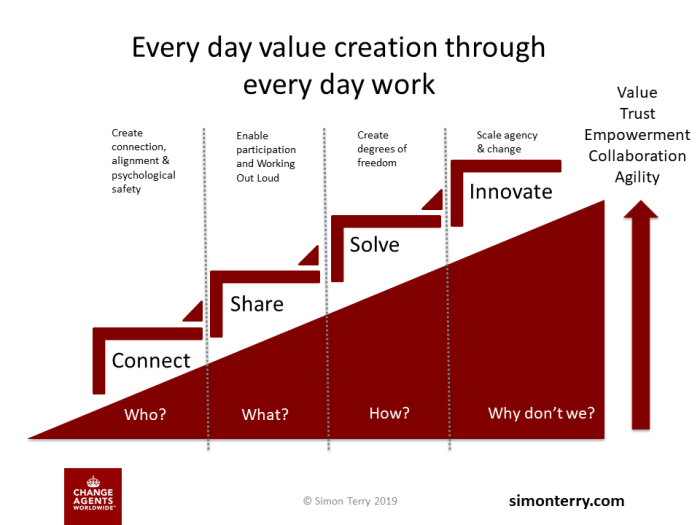
We can see how Chat, Conversation and Collaboration mature across the four stages of the Collaboration Maturity model in the following chart:

  • Connect: bringing people together can start some chatter and enables the initial conversations around people and alignment.
  • Share: Chat is now well developed and the sharing in the network helps develop alignment. People are beginning to be inspired to action by the sharing going on, but this action may not be visible or be in other domains.
  • Solve: There is a rich environment for awareness and the potential of networks to solve issues of alignment is being explored well. The benefits of problems being solved is inspiring an increasing level of action and engagement from employees
  • Innovate:  Effective innovation requires all three to be operating at a high level and the ability to bring the whole organisation’s systems to bear on challenges and opportunities. This level of collaborative performance requires a high level of trust to have been created through the experience of growing maturity.

Here’s a table to reflect how each stage can be mapped.

Aware Aligned Action

This discussion to date has been agnostic of the tools you might choose to conduct chats, conversations and collaboration. As I have noted previously, these human behaviours relate to patterns of human interactions but can be mapped to a range of features of different collaboration tools. Different features of different tools address the various elements of awareness, alignment and action to differing degrees. Most importantly your tool will have significant impact on the shape of what is known and what is unknown. This can be a critical issue in awareness, alignment and action and the resulting value created (a topic for a future blog).

In addition, you will always find users whose preferences differ and they seek to execute the behaviour in unusual ways to suit their perceptions and needs. At times there may be a need for chats, conversations or collaborations to improve awareness, alignment, and action for these users.

Most important in achieving the goals that management want to see from these tools are key questions that must be address in the adoption of any new work behaviours:

  • what is the culture of the organisation now and what does it need to be for success?
  • How open and transparent can we be with information?
  • How well shared is the information, understanding and work of the organisation to begin?
  • What is the pace of change and adaptation?

The key challenges of management can be easily and effectively addressed by encouraging adoption of both inner and outerloop work tools and the use of both in combination. Designing and supporting that adoption in organisations requires a focus on the human change that will ensure success.

Unrealistic Ambitions

Your ambitions don’t have to match your expectations. What’s realistic is not a limit to what should be attempted. Knowing your ambitions are unrealistic but pursuing them anyway enables growth, learning and can support happiness.

Happiness and Expectations.

Rachel Happe shared this great advice on Twitter:

Happiness is often shaped by the gap between expectations and reality. Too often people lose touch with what’s actually going on and their expectations become unrealistic.

This is never truer then when people are enthusiastically promoting change. Enthusiasm can often drift into an unwillingness to listen to others concerns and a certainty of success that is unfounded. Enthusiasm often creates unrealistic expectations.

Remaining engaged with the community around your work and listening actively to their views is critical to keeping a realistic view of expectations. This engagement is where you will find the real barriers to you success and the opportunities to be leveraged.

Expectations and Ambitions

Unfortunately, many take the view that their ambitions should be what is expected (or less). Unwilling to fail or be disappointed they set their ambitions in the safe and comfortable zone of expectations.

However, expectations are rarely a single certain outcome. They are usually a wide probabilistic range. The safe zone gives up a lot of improbable but still possible territory. This is where ambition and expectations can safely diverge.

I’ve struggled with many people at work and in life generally over the idea you can have extreme ambitions and moderate expectations. There is always someone in the team who will say ‘that’s unlikely. What should we bother?’ This is usually met with ‘If it is likely, why should we bother?’ The zone of discomfort where our ambitions exceed our expectations is where we start to grow and realise our potential.

Many people think ambition must equal expectation but that is a path to either unhappiness or underperformance. Lift you expectations to unrealistic ambitions and you will be disappointed. Sink your ambitions to what is realistic and you won’t grow your potential or create meaningful change. The status quo isn’t what you are seeking to reinforce.

It is important to note I’m not advocating the unrealistic expectations that come to those with privilege. People may be ordained to have high expectations. Effort in the circumstances, fair or unfair, determines who succeeds. Failure is real and likely. As I have suggested before change agents need to be wildly optimistic and have the cold hard clarity of reality before them. Privilege and all the systemic barriers to success are good reasons to separate our ambitions and our expectations. Sustained effort, happiness and growth comes more easily when ambition and expectations are managed separately.

What’s realistic is not a guide to what should be attempted. What’s realistic is telling you what will happen most likely based on averages. Your efforts have a chance to change that. Set yourself some unrealistic ambitions but hold realistic expectations and you will balance happiness and surprising success.

Don’t Make It Easy

Don’t make collaboration easy. The greatest value comes from tackling the hardest and most complex challenges.

Confusing Ease and Adoption

A lot of the focus of community managers promoting adoption of collaboration solutions when starting out is how to make it easier for employees. Rightly, community managers want to make it easy for employees to make sense of the solution and to create a positive and harmonious environment that doesn’t attract opposition from the at times hostile organisation.

However, an excessive focus on ease can undermine a community. Adoption of new ways of work requires a sense-making process of how to integrate the new ways of work into ongoing patterns. Make it too smooth and people may not have to think about what changes.

Worse too much comfort can undermine the clarity of the purpose of the collaboration. If all conflict is whisked away, if only good news is discussed and only easy things are done, employees will soon abandon the platform because it doesn’t ‘feel like work’.

Adoption is far more about delivering employees an opportunity to be clear on the purpose and value of collaboration than it is about making it easy for them. Go too far in doing the work for your employees and they won’t bring their participation or their biggest challenges.

Hard Work is the Valuable Work

Organisations need collaboration solutions to address challenges and to realise opportunities that can’t be delivered by the usual silos and processes. Fixing things outside of the system is not easy but it is the most valuable work your collaboration network can do.

Community managers need to invite complex challenges into their communities and invite employees to contribute their best talents to their solution. Without the contribution of a whole organisation’s worth of ideas, insights and efforts the hardest & most complex challenges won’t be solved and as the community probes, senses and responds its way to a solution.

Complex challenges bring difficulties, failures and conflicts. If they were easy, they’d be solved by now. Inviting a community to tackle the big valuable issues means things are going to get hard and you need a community that is mature enough to have some grit and use its degrees of freedom.

Disequilibrium is a part of any change process. If you want the highest levels of value with scales and agile change then you will need a great deal of disequilibrium. The disequilibrium will facilitate change and new perspectives.

Don’t make collaboration too easy for your organisation. The best value and the best challenges will require some difficulty. Provide clarity on the work to be done and promote the passion and persistence to finish the job.

The Self-organising Disappearance

Self-organisation is one of the most common themes of the future of work. It is also the one most likely to disappear in the culture of organisations. Realising self-organisation takes more than new practices. Achieving sustainable self-organisation requires a focus on the culture of management and interactions.

The Self-organising Disappearance

Self-organisation is everywhere. Also, it disappears as fast as it is advocated.

Nobody was going to have a manager. Holacracy was going to bring self-organisation to all organisations but has ended up a niche practice at best. Agile is about enabling self-organising teams to deliver the projects they choose in the manner that best makes sense for them. However in many organisations agile is the way that project teams take orders in fancy new meetings. Open plan workspaces were to enable the new flat organisational models of the future but we just got the funky furniture and the negative impacts on productivity. Enterprise social was to enable widescale self-organising of collaboration but still we spend our time talking about the importance of senior leadership engagement. We could go on.

One issue is core to the failure of self-organisation in many of these approaches. We sold a new work practice that is predicated on a new culture of work, but we left out the culture change. The traditional management culture of efficiency, allocation, command and control embraced the new practices where required, but managed out the threatening and risky self-organisation. When culture is our expectation of how to behave in groups, that expectation will shape any fancy new process or practice.

In many cases, this was deliberate. Fearing that self-organisation was scary or difficult, advocates didn’t promote that element of the hot new practice. Leaving culture change to later is leaving culture change out entirely. In other cases, the scope of the implementation project was not wide enough to allow for sustainable change. Self-organisation doesn’t coexist well with traditional top-down budgeting, human resources and performance systems. Leave those out of scope and they will slow win back control. Many of the new practices were also complete systems that had been developed over time in a specific context. Imposing the practice without the context led to all kinds of inevitable adaptation opening the door to adaptation to suit traditional cultural models of management.

The Power of Self-organisation

Self-organisation is still a key part of enabling organisation to adapt in a digital age.  More businesses face the challenge of moving beyond the predictable repeatable process of work.  As they do so, they discover that top down process centric approaches to work are barriers to adaptation.

The pace of adaptation accelerates when organisations can engage all their employees in learning and initiating change. Self-organisational practices enable employees to quickly identify, test and adapt without waiting for management decisions to change processes, budgets, goals or team structures. Moving decision-making closer to the customer and closer to the edge of the business enables that decision-making to be more responsive to changing markets.

Importantly, self-organisation is also how organisations begin to tackle the pervasive lack of engagement and waste of human potential in traditional bureaucratic structures of management. Coordinating change in one’s own work enables a more direct line to purpose and the value of the work. It enables people to change their contribution to teams to better align to their potential and their growing capabilities. Our organisations come together to better leverage collective human potential. Once that was best done through the management of information and resources in a hierarchical bureaucracy. The challenge now is how we organise for the next level of performance in a competitive fast changing digital market.

Realising Self-Organisation

As noted above, there are many practices that foster self-organisation, but we often miss how they challenge our traditional management practice. Hierarchical decision-making, efficiency orientation, resource allocation through budgeting, inflexible processes and policy and tight metrics are how we ‘do business’. They are the cultural expectations we have of how things are done and they are rarely challenged or considered in organisations. It is for very good reason that any new change in an organisation is met with the questions “who authorised this?” and “do you have budget?”

Introducing self-organisation into your organisation should not be about throwing out the existing culture and incorporating another culture whole. That’s not how culture change works. People don’t embrace new cultural expectations because they are mandated. They are embraced through a process of adaptation, story telling and experience. New rituals are one part of that process but the practical experience of change is what is more powerful in shaping expectations.

Stepping into changes in the way management is done in your organisation also creates new risks. Existing management and their power structures will be rightly reluctant to embrace new risks and lose control of mitigating them at the same time. Organisations that want to move in the direction of self-organisation do so by building foundations for new ways of working that go directly to these anxieties in management.

Screen Shot 2019-06-14 at 10.06.52 am.png

Here are a few starting points that we will explore in future posts:

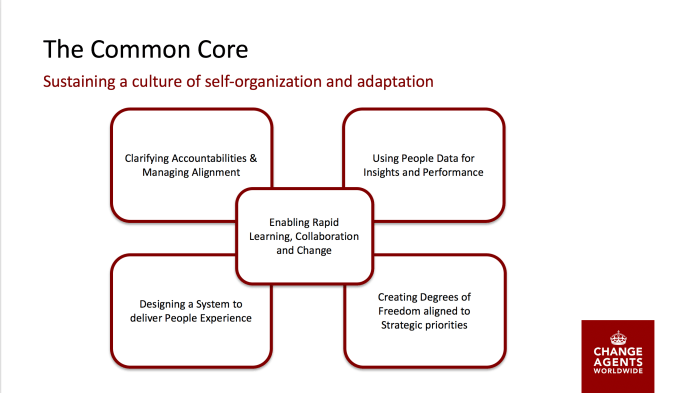
  • Accountability & Alignment: Most organisations claim to have an accountability culture. Few do. Often if they do, it is a culture of individual accountability at the expense of collaboration and alignment. Successful self-organisation requires individuals, teams and the organisation to get used to a dynamic process of managing changing accountabilities and aligning work to strategic goals and purpose. That dynamic process is as much about peer accountability as it is top-down. Organisations need to get get used to new hard conversations. Accountability and alignment must work together to support self-organisation.
  • Measurement & Transparency: Letting people manage their work doesn’t mean ignoring that work. Improving the management of work and learning what works involves a commitment to measuring well and using that measurement for the improvement process. Another shock to most traditional organisations is that self-organisation usually requires increased transparency of performance information to support the culture of accountability and alignment.
  • New People Experiences: Many self-organisation efforts fail because employees won’t embrace the new freedoms of work. Why? Because traditional people experiences mean that these new freedoms are risky. Until performance, job design, remuneration, learning, working approaches and career paths support the goal of greater self-organisation employees will be sceptical to be the only ones taking risks.
  • Degrees of Freedom: Self-organisation doesn’t have to be total. Organisations should adapt their own approaches based on the demands of their market, organisation, business model and strategy. Enabling the right degrees of freedom for employees to create change aligned to strategic value creation is the start. Organisations can then adapt their approach as their culture matures into new ways of working and as the results are delivered.

Do for, Do With or Enable

When managing the value of collaboration or other future of work activities, it is critical that we enable employees to exceed our expectations.

As a marketer, I came across research in many domains that highlighted that people have diverse preferences for the experience of choice and control. Some people like things done for them, some people like things done with their active participation and decision-making and then there are those who want to do it all alone.

Do it For Me

The practice of collaboration is maturing across organisations. Community managers and adoption specialists increasingly understand that we need to move beyond ‘do it for me’.

In the early days when the technology was new people found prescriptive approaches useful. They still demand them in psychologically unsafe environments because following an order is a form of thoughtless safety.

There will always be some part of the population that has a preference to be told what to do. However, this group probably won’t be the source of your greatest value creation.

Do it With Me

The Value Maturity Model of Collaboration above recognised that co-creation of value is a key part of effective collaboration. Employees want to work with others to break the shackles of traditional management and create new value.

Community managers must plan for this agile co-creation process. They need to leave activities and engagement open enough that it appeals to those whose preference is ‘Do it with me’. In this way, collaboration is an exercise in collective sense-making.

Enable Me To Do It

Much of what is said about generations is myth. However the highlighting of preferences for self-service and control in younger generations is an expression of the ‘I’ll do it streak’ in the whole community. The era now increasingly validates this choice and control and leaves us questioning the hierarchical command and control models of work and management.

Organisations need to enable the degrees of freedom for employees to do their own thing in creating value aligned to strategy. A key part of the approach to collaboration is deciding where these degrees of freedom are required and building employee capability to take advantage of it.

Independent action and agency is an important part of how people realise their potential. We come together in organisations to realise human potential more effectively than as individuals. Your collaboration plans should take account of all three segments – do it for me, do it with me and I’ll do it. This requires organisations to have a clear plan to align people around purpose, develop psychological safety and enable degrees of freedom in their employees.

Post #1000: How a thousand blog posts changed my life

I was pondering what to cover on the 1000th post on this blog. Rachel Happe responded to my query with an excellent suggestion of a topic:

https://twitter.com/rhappe/status/1131507469438586880

So here goes a wandering meditation on what I’ve learned on a multi-year journey of blogging.

The History

First, a little history.  I began blogging about 4 years before I published my first external blog post. When I worked for a large financial services organisation, I convinced one of the admins of the new SharePoint site to turn on a blog site for me. My goal was to blog every day about something I had experienced or learned in the day.

At the time, it was the only one in the organisation and there were a few risks in putting my voice forward which I mitigated by keeping the audience small at first. That blog was soon magnified by the network reach of a growing Yammer network. Quickly, other executives, usually far more senior, started their own blogging.

I created my first external blog on the predecessor of this site on Tumblr (seemed like a good idea at the time) a year before I left that organisation, which is around 6 years ago now. Three years of practice internally had helped me refine my approach and I wanted to share more externally, not just to the closed community of an organisation. About 3 years ago, I migrated all those posts to this site on WordPress and have continued to post consistently since, still trying to post daily much of that time.

Discovering my Voice

The first lesson of this experience was discovering that I had my own unique voice. I also learned that I should embrace my own way of writing, focuses and messages as a strength.  Success came when I said my thing, not when I tried to ape others.

When I started blogging, I read many ‘how to blog successfully’ articles. I experimented with the advice, but my own voice prevailed. Ultimately, I rejected much of their advice. I found I couldn’t blog on only one topic. I couldn’t use SEO keywords. I couldn’t tie my posts to current events consistently. All those suggestions are great if you want your blog to be like others. I wanted to say my piece.

When I started blogging, I was trying to replicate some of the posts of those I admired. People like Stowe Boyd, Lois Kelly, Harold Jarche, Euan Semple, Jen Frahm, Seth Godin, Esko Kilpi, Catherine Shinners and Susan Scrupski were role models for me. However, if you look at the work of those remarkable bloggers you soon realise that I couldn’t copy them. The world doesn’t need clones. It needs diversity. I needed to speak in my own way and do my own thing. When I stopped copying and started being me, I enjoyed it more and the engagement lifted.

Discovering my Purpose

When I began blogging consistently I had no idea what I wanted to do with my career. Exploring my ideas and passions on the blog became a way for me to discover and refine my purpose.

Discussing ideas on the blog, led others to raise questions and make suggestions. Purpose doesn’t exist for you alone. Purpose is about the impact you have on others and the change you enable. Expressing my purpose and putting it into action in that way helped me to refine it through the work.

Putting my Intent in the World

Putting my intent into the world through the blog and through the social engagement that it fostered solved what I wanted to do next. When I saw my perspectives and ideas were unique, could add value and be valued by others, it helped me to develop the confidence to build a consulting practice.

The reputation fostered by putting this intent forward has led to work and speaking opportunities that helped reinforce my purpose and give me the chance to practice. The consistent practice of blogging has also been a way to refine and learn in that work.

Connecting with Communities

Blogging has been a path to meet others who share my purpose and to exchange ideas with them.  My practice on the blog led to a wide engagement with the Yammer Customer Network, meeting the Change Agents Worldwide community, becoming a leader of Working Out Loud week, joining the Yammer MVP community, engaging more deeply with Learning practitioners around the world, working with healthcare communities, joining the Responsive Org community and many more.

Blogposts became the topics of discussions on twitter chats and forums around the world that led back to new interactions and relationships that enhanced my practice and my networks. Not all of those interactions were situations where people thought my posts were right, but I have been lucky to largely avoid the ire of others for what I have said.

Reflecting, Learning and New Practice

In a busy world, time to reflect on what we do is a gift. Communities to share that reflection process are a blessing. Learning new ways of working and being able to share new ways of practising that work are the benefits.

Over 1000 posts, I have learned a lot about myself, my work, my relationships and my world. Some of the biggest and most personal learnings don’t show in words on this blog. They were side benefits of the work. Others are here but the personal learning has been spun into its organisation context and buried back into a richer and more human approach to the work I do.

This blog has a small audience. There are probably more posts, than consistent readers. It is not a numbers game. I won’t win any awards. There are many posts with only a handful of readers. I once found a post that only I had read. I blog mostly for myself. Many of my posts are a process of working out new actions or exhorting myself to improve my practice. Put that intent out there and it helps you to deliver against it.

A System for Daily Practice

To even go close to write a post every day, I had to build a system to enable that to happen. That system was built around a few key elements:

  • the habit of writing: I sit down most days with my first cup of coffee and I write. The coffee is the trigger and when I was a consultant and not every day was booked blogging was my trigger to start work. That’s how I start my day and my goal is to publish a post at the end of each writing session
  • working out loud: to publish in one session you can’t be a perfectionist. You have to embrace that the post is a part of a journey, not the end point. It also allows for you to revisit or develop posts later in further blogposts.
  • a format of a post: to publish in one session you need to have a simple idea, developed, supported and expressed concisely usually in around 500 words. Larger ideas are broken down into their components and played out over a number of days.  I’m not always the best editor of my own work but this length allows time for a few read throughs and amendments before publishing.
  • a pipeline of ideas: I take notes continuously on paper and online. I’ve always compiled long lists of ideas for candidates for blogs, even if it is just a title that I save in WordPress as a draft post. When I am stuck, I work through that list, edit an abandoned draft or use some of those ideas as inspiration for a new topic.
  • looking for connections: I accumulate connections that enhance the pipeline of ideas. When you have a post in the pipeline, you inevitably see other materials that are relevant and can be related. The connections are there, but we often don’t go looking.
  • inspiration: Picasso is reported to have said ‘inspiration exists, but it has to find you working’. I agree. The practice of writing daily made it easy for inspiration (or even suggestions) to find me.

New Attention

I am much more attentive to the world around me, because I write consistently. I know I need to feed the pipeline of ideas, to research connections and to have material to share. When I see interesting work, I follow and I engage with those people because it helps me to learn.

Attention only happens with focus. The topics that this blog addressed helped me to focus on a narrower range of areas that I want to learn and to write. My reading and conversation tastes are eclectic, but focus helps me to find relevant gems in even widely divergent domains,

In an era where we are easily distracted, focus and attention is a gift. It is also the only way to get things done.

Mastery

Writing is a humbling task. There are no perfect words and no perfect ideas. No matter how long or how well you do it, the next page starts blank. You can learn some tricks of writing, a pretty vocabulary and some flowery grammar, but you have to do the work.

The post of which you are most proud will be ignored. The post that was a late night rant of frustration will strike a chord with others. The perfect idea will seem stupid the next day. The post that took weeks will never be published because it never resolves the right way. There will always be spelling and grammatical errors. Jokes will be misunderstood. You will hate editing your own work. Whatever happens the next day you get up and write again.

Writing is a perpetual reminder that life is a process of mastery. We make each effort better than the last. We build on what we do and we learn and we do again. A little humility helps.

Clarity

Writing a lot helps bring clarity. It helps you to express ideas in simple jargon-free language (mostly). It exposes when your own ideas, your expression, or your own goals are muddy.

With the tools available to us, it is easier than ever to write a lot and say nothing.  That is particularly the case when all you do is paraphrase others. Clarity of the value that you add and how your view is different is important. Sometimes people are craving a clear stand. Be brave enough to be wrong.

The ability to clearly express and simplify an idea in a single sentence so that you can share it with others is the greatest challenge. I know I have made a difference when someone finds that sentence and highlights it.

Privilege

I am the beneficiary of much privilege. You can see the privilege in the assumption that anyone wanted to read my writing when I started.

The process of blogging and engaging with wider communities has helped me to understand that others don’t start from the same place or get the support that I got to write. I am now far more aware that my experience is not universal and that others need help to share their voice, to benefit from and to feel safe doing so. I can’t be aware of that and be neutral, so I see that as something I want to address in my ongoing work. If work is to be more human, then everyone needs to feel able to realise their human potential.