The Last Thing We Need is an Enterprise Social Network – the video
(Source: https://www.youtube.com/)
Chair and Non-Executive Director, Advisor, and CEO helping healthcare, finance, and educational organisations drive growth, leverage technology innovation, and realise the strategic value of transformation
The Last Thing We Need is an Enterprise Social Network – the video
One-minute video on 3 Simple Steps to Create a Habit of Working Out Loud.
And there is a Poster too.
A key role for leaders is to authorise discussion in organisations. Leaders need to foster frank and authentic discussions by all employees. The best way to signal willingness to discuss the real issues is to start that conversation yourself and to show you will take action on the outcomes.
How do you invite questions?
I was recently asked what was my favourite aspect of a YamJam was. A YamJam is a Q&A session in Yammer usually by a leader or other authority figure. My answer was that my favourite element is that a YamJam authorises employees to question leaders and role models. This starts to create the kind of leadership that employees want: open, authentic and responsive.
Working out loud by leaders has the same positive impact. By openly sharing the work in progress with all its doubts, flaws and uncertainties, leaders invite others to engage them on that work. They make transparent their personal work processes for the benefit of others. The sharing authorises others to engage and respond to the leader’s work. This is a powerful tool to cut through hierarchy and change leadership interactions in an organisation. Change the interactions and you change the culture.
Authorise the debate
The greatest barriers to human potential are the things we think we cannot do. Too often we look for others to authorise us to act. For many people and organisations, questioning leaders falls into the category of some we can’t do without permission. The role of leaders in realising potential is to release this constraint and authorise the kinds of generative conversations that enable organisations to be responsive.
Working Out Loud is a key practice for learning in networks. Working Out loud creates value by surfacing opportunities to collaborate and to exchange information around work. Sharing work creates value for both the person sharing their work and others who observe. However, it can be a challenge to convince someone upfront that the value exists.
What is Working Out Loud?
Bryce Willams initially proposed the concept of Working Out Loud as:
Narrating Your Work + Observable Work
The concept has been developed by a number of others, particularly John Stepper, and there are many related concepts, such as Jane Bozarth’s Show Your Work. With the increased transparency, access and visibility of networks in the digital era, working out loud is a much easier and much more productive practice. Working out loud enables others to see, understand and contribute to your work. That delivers benefits for both workers and observers and can play a critical role in shortening the time cycles of feedback, learning and collaboration.
You Can’t Predict the Value of Working Out Loud
Many people are reluctant to share their work for fear of negative feedback or fear of others’ perceptions. People look to overcome their uncertainty by clarifying the benefits.
However the benefits of working out loud are as unique as the approaches of each individual and the diversity of their networks. Like many forms of social collaboration, there aren’t guaranteed outcomes in terms of benefits and the benefits are tailored to an individual’s situation and needs. Importantly benefits can flow far from the individual who is working out loud. This latter point is important in corporate context’s where working out loud can play a key role in improving alignment, reducing duplication and facilitating learning on the job.
I have learned to work out loud in a number of ways. My blog is an ongoing meditation on lessons from my work. I leverage twitter, public and private groups and social streams to share work in progress with others and get feedback. As someone who is relatively new to working out loud I have found that the benefits of working out loud are always a surprise and exceedingly diverse:
Working Out Loud Requires Experimentation
The form of working out loud will differ for each individual depending on their work, their comfort in sharing, their expertise in social tools and their network. There are few formulas that can be prescribed that are generally applicable.
The best advice for an individual seeking to benefit from working out loud is to experiment with what works for them. A process of adaptation and experimentation will help each individual to develop a set of practices which enables them to be most productive.
If you are looking for a place to start, start by trying to form a new habit and adapt your practice to what suits you and delivers you & your network the best benefits. Consider forming a working out loud circle to help accelerate & share your learning with others. Look out for the next International Working Out Loud Week, a great opportunity to develop your practice of working out loud in the company of a network of global peers.

The story is too common in the modern organisation: a team has a member who is not contributing but they go on being a part of the team for months or even years. Waste, frustration and disengagement mount in the team. Despite the negative impacts and length of time the manager responsible does nothing to rectify the underperformance.
We have more performance data than ever. We have more sources of information than ever. We interact in more ways than ever. We live in an age of increased performance transparency.
How Can Sustained Underperformance Be Common?
All that data, information, interaction and transparency brings more for managers to do. Complexity is the fundamental challenge of the modern manager and without careful husbanding of their attention the time of the manager can be subsumed into busy work.
Continuous partial attention has crept into management practice. Challenged to keep up managers are constantly skimming across the top of the work. Interactions with employees are staccato bursts. Busy managers spend less time understanding what is actually going on. Flitting in and out of observation of their employees, managers can be lulled into a false sense of confidence if the numbers look good.
For an under-performing employee that means the ability to escape action continues as long as the deadline has not yet arrived, the numbers look acceptable and underperfomer has an answer for the first quick query from a manager. The commonest trick is for the under performing employee to send their busy manager an email asking for a complex decision. Likely overlooked or deferred, it becomes an instant performance excuse. Instead of asking for help the employee uses the pressures on their manager as a chance to hide their performance issues. Time, pressure and waste mount up.
In rare cases, managers may see the problem situation but the pressure of other demands means that they do not prioritise action. They trust in the systems, the employee’s peers or the reporting to correct the underperformance or hope that the employee’s lack of action is temporary. These managers prioritise the work and the system over their people to the detriment of everyone.
Refocus the Attention of Management on the Process of Work
Psychological studies show that multitasking & continuous partial attention don’t work. People who practice these approaches feel that they are more effective but aren’t. We need managers to get off the treadmill and reconsider their approaches to performance:
Great managers shape the process and performance of the team. Great managers enable every member of their team to realise their potential and contribute to creating a more responsive organisation. They are not slaves to the reporting, information and decisions that flow through them. Managers must step out of continuous partial attention to the ongoing work process and get involved in the design of the work.
The work of leadership is to realise the potential of people. Leaving someone stuck in a rut of continued underperformance is failing that individual’s potential.
A guest post on the Disrupt Sydney blog. Tickets for Disrupt Sydney are now available. In addition to a debate on gamification, I will be helping facilitate the anti-panel again.
Start where you are. Use what you have. Do what you can – Arthur Ashe
Sometimes the honest approach is to agree to pretend for a little while.
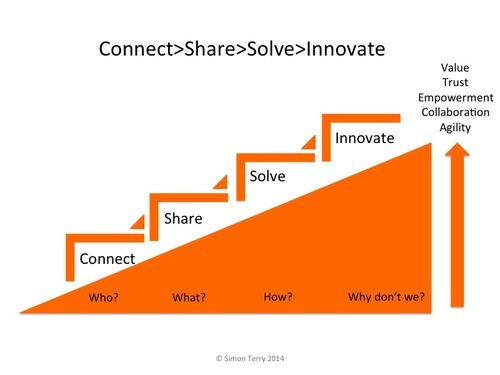
The difference between a network and community is a culture of collaboration. Collaboration doesn’t just happen. It is grown through the action of leaders.
Markets are Value Networks
The markets we use when we exchange financial value today are networks. Networks of connected agents exchange value in our stock exchanges, banks and risk markets. These networks did not arise simply because people connected. Financial markets are facilitated by practices that help transform connection into valuable interactions.
When the networks of merchants in coffee houses became stock exchanges, they relied on the role of brokers and market makers to help build a valuable marketplace. These roles helped people:
The same leadership work to build value, trust and new ways of working is found in the history of banking, insurance or other exchanges.
The value created in these networks did not occur because the network existed. It occurred because of the work of people to build a collaborative culture in the network. People need to build a sense of how to use these new exchanges and to build trust in that they would deliver more value than risk.
Your Network Needs Market Makers
Any collaborative network will need leaders to help facilitate the creation of value in the network. This leadership will be a combination of technical support from community managers and change leadership support from change champions in the organisation and the organisation’s senior management.
The Value Maturity Model highlights the way that collaboration’s market makers need to work to facilitate the value creation in your network:
To maximise the value of the networks in your organisation, you will need to develop the leadership capabilities that can take advantage of networks.
If you would like to create greater value in your enterprise social network or discuss how the Value Maturity Model applies to assist your organisation to create strategic value, please get in contact. I am available through @simongterry or Linkedin or www.simonterry.com